
BSI x CNP Symposium
Date: 17-11-2026
Registration: https://questions.socsci.ru.nl/index.php/924115?lang=en
About BSI x CNP Symposium
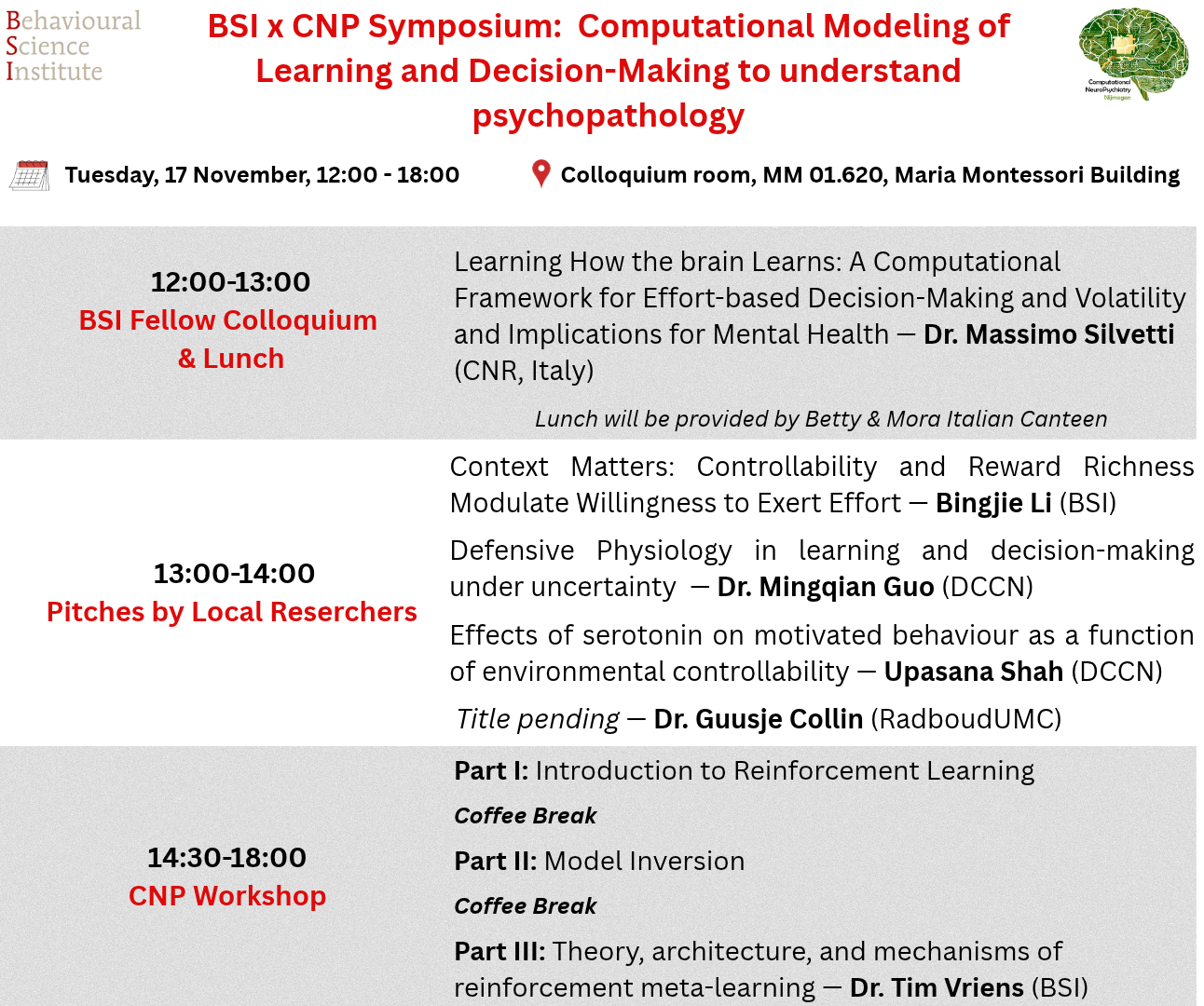
Integrating neuroscience, psychology, and computational modeling, this session will explore how meta-learning and neuromodulatory mechanisms shape motivation in healthy functioning and psychopathology (e.g., ADHD, depression). During the colloquium, Dr. Massimo Silvetti (Institute of Cognitive Sciences and Technologies, CNR, Italy) will discuss how computational models can be leveraged to capture the brain’s meta-learning processes, focusing particularly on motivation, decision-making, effort, and volatility. Following the colloquium lecture, pitches by local researchers (BSI, Donders and RadboudUMC) will showcase ongoing research on decision-making, computational modeling and psychopathology. The event will conclude with a hands-on workshop organized by the Computational Neuropsychiatry Nijmegen (CNP), offering participants the opportunity to gain practical experience with reinforcement learning models and meta-learning algorithms.
Program Overview
Abstracts
About the Colloquium
Dr. Massimo Silvetti
Institute of Cognitive Sciences and Technologies, CNR, Rome, Italy
Every day, our brains make countless decisions—not just about what action to take, but also about how much effort to invest, how much attention to allocate, and how quickly to adapt when the environment changes. Recent findings in cognitive and computational neuroscience suggest that this process is best understood as meta-learning—the brain’s ability to tune its own learning strategies to maximize outcomes (e.g., reward and information). In this talk, Massimo Silvetti, an expert in computational modeling, will introduce the Reinforcement Meta-Learner (RML). The RML is a neurocomputational model that bridges decision-making, motivation, effort allocation, uncertainty and volatility management within a system-level neuroscience perspective. This model proposes that adaptive control of neuromodulators (i.e., dopamine and norepinephrine) allows the brain to flexibly adjust its learning and decision-making in real time, creating a feedback loop between brain dynamics and behaviour. Importantly, by tuning parameters corresponding to these key neuromodulators, the RML can simulate behaviours typically seen in disorders such as major depressive disorder (MDD; e.g., low effort allocation for reward). Specifically, Massimo Silvetti will show how the RML explains core processes such as cognitive control and effort-based decision-making, as well as volatility estimation (detecting environmental change via prediction error and adaptive gain) in foraging decisions (choosing whether to exploit or explore). Next to this, he will discuss how the RML framework can generate mechanistic hypotheses about two high-prevalence psychiatric disorders—ADHD and MDD—and present preliminary data evaluating these predictions.
This event is designed for researchers across disciplines—neuroscience, psychology, education, work, health, and beyond. No background in modeling is required; we will introduce key concepts like meta-learning, adaptive gain, and neuromodulators in accessible terms.
About the CNP Workshop
Dr. Tim Vriens
Behavioural Science Institute, Radboud University, Nijmegen, the Netherlands
This workshop will provide hands-on experience with basic reinforcement learning modeling techniques and introduce the reinforcement meta-learner (RML) model. The workshop will consist of three one-hour sessions. The first session, “Introduction to Reinforcement Learning,” will introduce the fundamental concepts and principles of reinforcement learning. The second session, “Model Inversion,” will focus on the practical application of model inversion within a reinforcement learning framework. Finally, the third session, “Theory, Architecture, and Mechanisms of Reinforcement Meta-Learning,” will explore the theory and computational mechanisms underlying reinforcement meta-learning.