DCC X Computational Neuropsychiatry Symposium
Date: 20-01-2026
About DCC X CNP Symposium
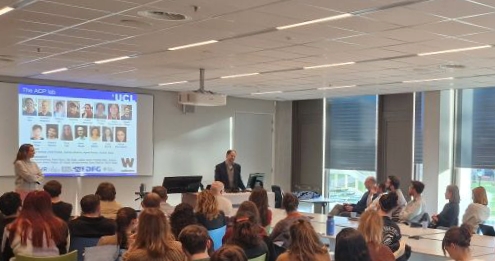
The DCC X CNP Symposium was a one-day event that focused on exploring how computational modeling approaches can be leveraged to unravel the specific mechanisms targeted by different psychotherapeutic interventions.
The DCC X CNP Symposium was
organized by the Donders Centre for Cognition in collaboration with the Computational Neuropsychiatry Platform (CNP).
Event Highlights:
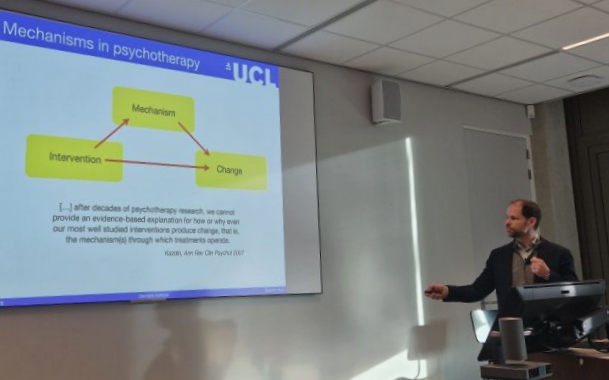
- Keynote Lecture: Prof. Quentin Huys (UCL, Max Planck UCL Centre for Computational Psychiatry) presented on computational approaches in psychotherapy.
- Local Talks: Egbert Hartstra (DCCN) presented on the role of the mPFC in estimating controllability and the association with depression.
Imogen Leaning (DCMN) presented on identifying clinical signals in behavioural smartphone data.
Paul Lagerweij (RadboudUMC Psychiatry) presented on Pavlovian-to-instrumental transfer in depression.
Keynote Abstract
Computational psychiatry attempts to translate advances in computational neuroscience and machine learning into improved outcomes for patients. Here, I describe recent work on mechanistic approaches to support the correct assignment of psychotherapeutic interventions to individuals.
Psychotherapies are one of the core treatment options available for depression. However, despite an extensive theoretical basis for interventions, our understanding of the underlying mechanisms mediating treatment response remains poor. Here, I will describe work suggesting that a combination of computational models and cognitive tasks may enable the measurement of the cognitive processes engaged by therapies. Critically, for the case of cognitive-behavioural therapy for depression, we find a double dissociation, with effort-reward tradeoffs engaged preferentially by behavioural activation, and learning about attributions preferentially altered by cognitive restructuring. Furthermore, improvement in symptoms in a realistic treatment setting is related, and possibly mediated, by changes in Pavlovian biases measuring using a task and a computational model. By contrast, exploratory analyses of Pavlovian aversive biases in a randomized controlled trial of sertraline appeared to increase early on in treatment responders. Finally, the cognitive measurement process enables us to design novel training interventions.
Program Overview:
- 10:30 - 11:30 | Keynote Lecture by Prof. Quentin Huys
- 11:30 - 12:30 | Short Talks by local researchers